The projected transfer of 13.9 million homes owned by older Americans by 2036 would represent a substantial change in who owns the country’s housing. It doesn’t, by itself, signal a sudden national flood of listings. Realtor.com estimates that roughly 1.3 million to 1.5 million homes will change hands each year over the next decade, a pace that gives buyers and sellers time to respond as homes become available.
That distinction matters because a transfer of ownership isn’t always a conventional sale that puts a home on the open market. The projection describes homes changing hands; it doesn’t say that all will be listed at once, or that every home will suit buyers looking in a particular area. The headline number is large. Its market effect depends on where the homes are, when they change hands and what happens to them next.
A decade of turnover, not a single wave
The phrase “silver tsunami” suggests homes arriving all at once, as if a national event would suddenly give buyers a flood of new choices. The available projections tell a slower story: longtime homeowners will make housing decisions over time, and their homes will pass to new owners through that process. Spread across a decade, the change is better understood as ongoing turnover than a single surge.
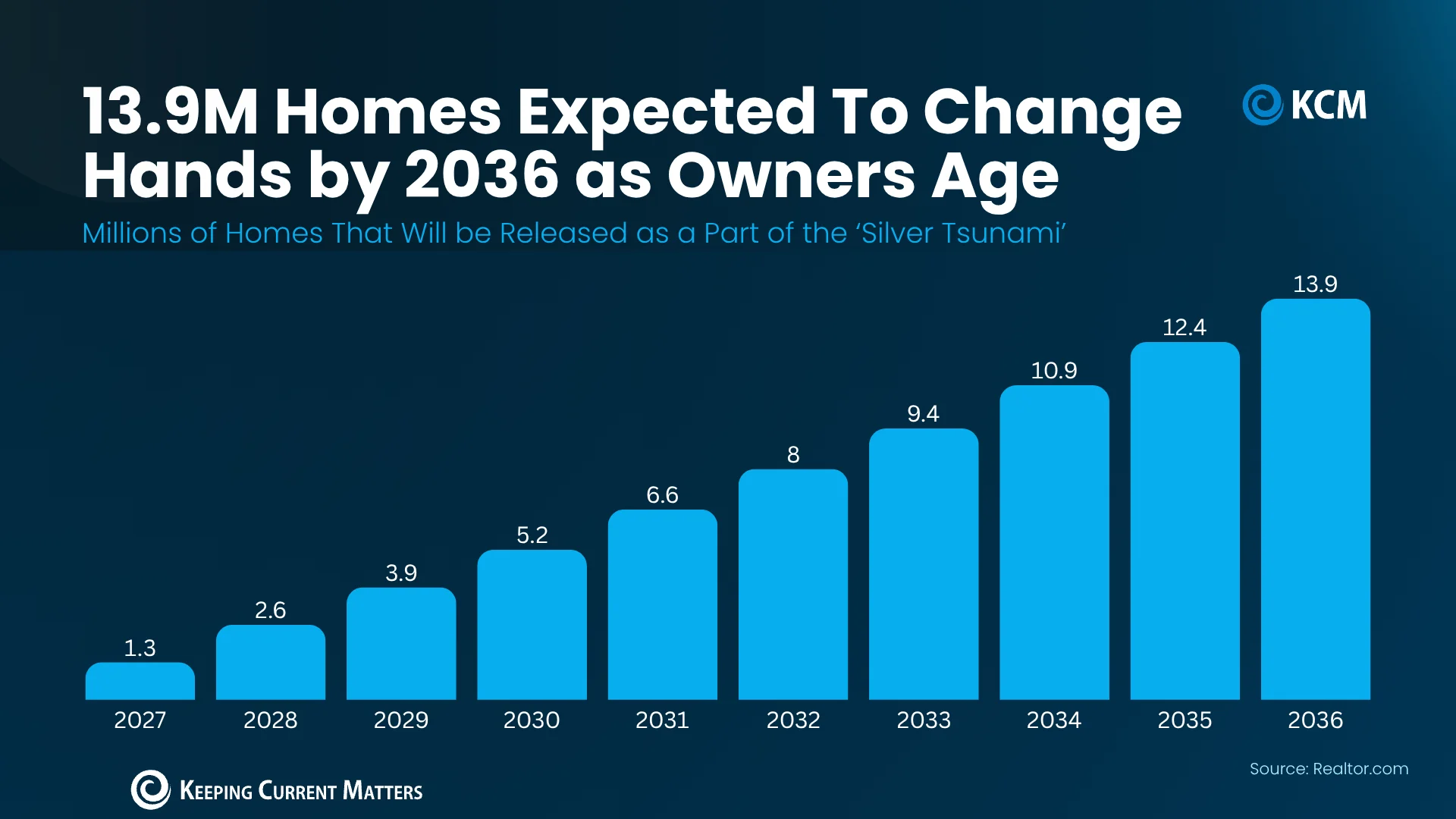
That distinction matters for sellers trying to judge competition. A national estimate spread across ten years doesn’t describe the number of homes buyers will see in any one neighborhood or season. Even if the annual total is substantial, supply reaches buyers in specific places at specific times. National averages can obscure that uneven pattern.
Nor does a home changing hands automatically mean a new listing will compete with a nearby property. The projection alone doesn’t explain whether homes will be sold, transferred within families or otherwise change ownership. That uncertainty is a reason to treat the “tsunami” label cautiously. It describes the scale of a generational transition, not a precise forecast of listings in any local market.
New supply meets a long-standing shortage
The U.S. housing market enters this period after years of underbuilding. Construction slowed sharply following the 2008 housing crash, and the resulting shortage remains substantial. Estimates differ, but the White House Council of Economic Advisers has described the scale of foregone construction this way:
“If homebuilding and the growth of the single-family housing stock had continued at their historical pace instead of falling dramatically after 2008, there would be 10 million or more additional single-family homes today.”
The additional homes changing hands could help meet existing demand. But turnover doesn’t build new housing; it makes existing homes available to different owners. The distinction matters in a market where years of slower construction have left a substantial gap between the housing stock and what might have been built at the historical pace cited above.
At the same time, more households are expected to form during the coming decade, creating continued need for housing. The supply shift, then, is taking place alongside demand rather than in a vacuum. A home transferred to a new owner may offer a choice to a buyer, but the national figures don’t establish whether that choice will be affordable, appropriately sized or located where demand is strongest.
For buyers, a gradual increase in available homes could widen the range of choices. For the broader market, it may contribute to better balance over time, though the effect will vary by location. This is more significant than it looks, but the number of transfers alone can’t tell us how much relief any one community will feel.
Local conditions will guide sale strategy
For homeowners considering a move, the national projection offers little reason by itself to delay. The practical questions are local: how many comparable homes are listed nearby, how quickly they’re selling, and what buyers are responding to now. Those conditions say more about the competition a seller faces today than a decade-long national estimate can.
That’s because buyers make choices among the homes they can actually see and afford in the area they’re searching. A broad increase in ownership transfers may not translate into more direct competition for every seller. And yet, if similar homes reach the same local market around the same time, buyers may have more alternatives. Timing and location are doing much of the work here.
Those details shape pricing, preparation and marketing. A local agent can help sellers assess the competing listings, review actual sale prices for similar properties and identify the features buyers value in the area. If you’re working in this space, the useful conversation is about what’s happening in the seller’s neighborhood now, alongside the longer-term change in ownership.
My read is that the “silver tsunami” is best understood as a gradual change in ownership, not a near-term market shock. Sellers will get a more useful signal from current neighborhood conditions than from a decade-long national forecast.
What the projection can—and can’t—tell us
The estimate gives readers a sense of scale: millions of homes are expected to change hands over the coming decade. It also puts that shift in context. The projected transfers arrive in a market shaped by a long-running housing shortage and continued household formation, so the added supply will be absorbed alongside ongoing demand.
Here’s the thing: a national projection is a starting point for asking local questions, not a forecast of what a specific seller will face. It doesn’t say how many homes will be listed in one town, what condition they’ll be in, or whether buyers will consider them substitutes for nearby properties. Those answers will emerge unevenly as ownership changes. For sellers, the neighborhood evidence is the part that counts. A gradual shift, spread across years and places.

|
Members: Sign in now to set up your Personalized Posts & start sharing today!
Not a Member Yet? Click Here to learn more about KCM’s newest feature, Personalized Posts. |