Lower borrowing costs brought more buyers into the mortgage market last week, though activity remains well below year ago levels. Total applications rose 6.2% for the week ending Nov. 6, according to the Mortgage Bankers Association’s Market Composite Index. The increase points to a short-term response to easing rates, but one stronger week doesn’t establish a sustained recovery. The year-over-year comparison is still the more sobering measure.
Purchase applications increased 8% on a seasonally adjusted basis, while remaining 18% below the same week a year earlier. The MBA’s average contract rate for a 30-year fixed mortgage with a conforming balance slipped to 7.21% from 7.3% the previous week. A year ago, the average was 5.99%. In Freddie Mac’s separate survey, the 30-year rate eased to 7.18% from 7.21%. The weekly moves were small, and the two surveys measure rates differently, so their figures shouldn’t be treated as interchangeable. Still, both show a slight retreat in borrowing costs.
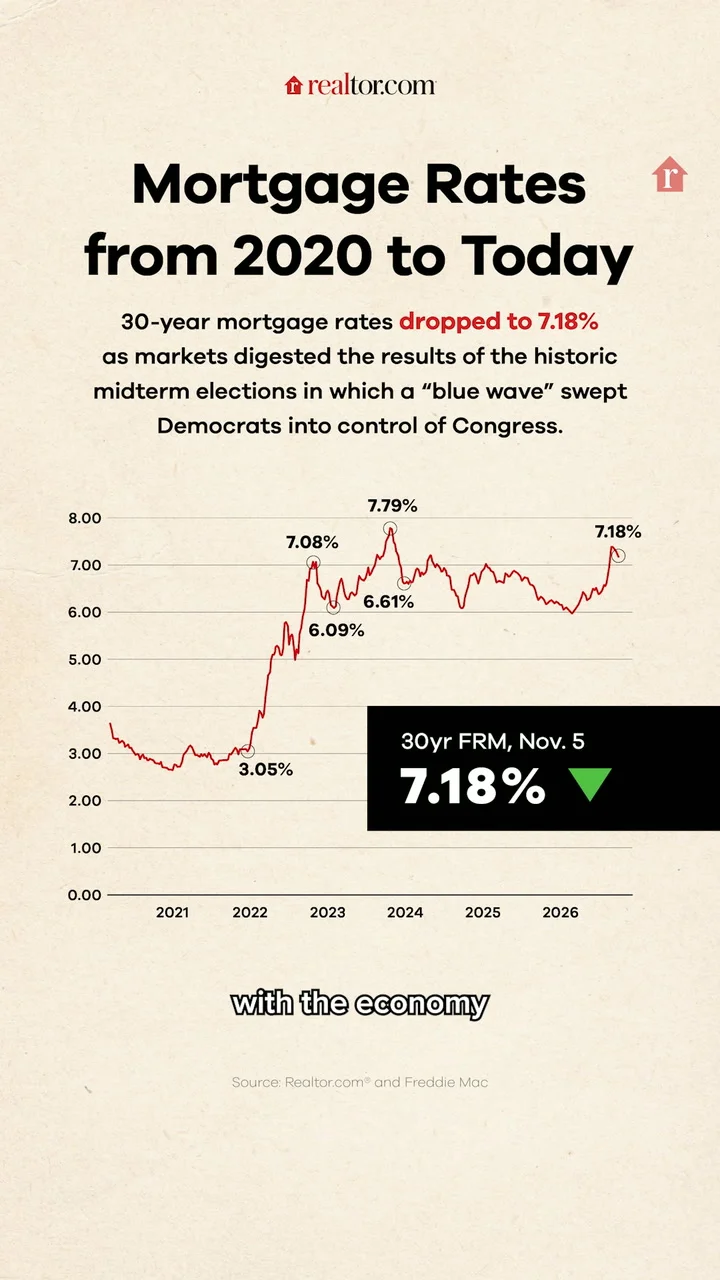
“Mortgage rates declined for the fourth straight week,” said Joel Kan, the MBA’s vice president and deputy chief economist. He said the rate trend supported stronger application activity, even as purchase and refinance volumes remained considerably lower than a year earlier. That distinction matters: a change in direction can bring some buyers back to the market without making homes affordable for households that are still facing much higher borrowing costs than they did last year.
Loan mix shifts as demand picks up
Adjustable-rate mortgages accounted for 10.9% of applications, down from 11.4% the prior week. FHA loans represented 15.5% of applications, compared with 16% a week earlier. The VA share grew to 12% from 11.2%, while USDA’s share edged down to 0.5% from 0.6%. These are changes in the composition of applications, not a direct measure of how many households received loans. Kan said FHA and VA loans saw particularly strong growth during the week.
The shifts were modest, but they offer a view of which channels gained ground as applications rose. FHA and VA programs serve different borrower groups and have different eligibility rules, so a larger share doesn’t by itself explain why applicants chose those products. And the smaller adjustable-rate share suggests the weekly pickup wasn’t driven by a growing share of borrowers choosing that loan structure.
Refinancing made up 39.8% of mortgage activity, unchanged from the previous week but 57% below its share a year earlier. Many homeowners continue to hold mortgages with lower rates, limiting refinance demand even as current rates retreat. For those borrowers, a refinance has to offer enough benefit to justify replacing an existing loan; a small weekly rate decline may not be enough to make that calculation work.
Economic signals complicate the rate outlook
The four-week decline in mortgage rates came alongside a stronger employment picture. The October jobs report showed the U.S. added 165,000 nonfarm jobs, a result that has increased expectations of a Federal Reserve rate hike at its December meeting. CME Group’s FedWatch put the probability of another hike at about 77%. That probability captures market expectations at the time, not a final decision. A strong jobs result can affect views about inflation and monetary policy, while mortgage rates also respond to bond market movements and investor expectations.
Midterm election results added housing affordability to the policy conversation. Democrats, many of whom campaigned on affordability, won majorities in both the House and Senate. In a CNBC survey, housing costs ranked among the top political issues for voters aged 18 to 34 and men aged 18 to 49. Former Federal Housing Commissioner Frank Cassidy described the results as a “wake-up call,” saying housing affordability “can't be ignored anymore.” The survey offers a measure of voter concern, while the election results show that affordability has become part of the political debate. Neither, on its own, tells buyers when financing costs will fall or how quickly policy discussion will translate into changes they can feel.
What sits behind mortgage pricing
Mortgage rates respond to economic conditions, while a borrower’s credit score and loan term affect the rate they qualify for. For 30-year mortgages, lenders commonly use the 10-year Treasury note as a benchmark because many such loans are paid off or refinanced within roughly eight to 11 years. Lenders add a risk premium to that benchmark. The quoted average rate is therefore a useful market signal, but it won’t necessarily match the offer available to any one borrower.
Treasury yields, in turn, reflect factors including demand for U.S. government debt and investor expectations for inflation. The recent drop has helped lift weekly purchase applications, but the gap from last year shows that lower rates alone haven’t yet restored prior levels of buyer activity. Mortgage pricing can move as expectations change, so four weeks of declines don’t settle the direction ahead.
What the latest increase means for buyers
This is more significant than it looks as a signal of interest returning, but the scale of the rebound needs perspective. An 8% weekly increase in purchase applications is encouraging for sellers and lenders watching demand, yet applications remain 18% below the same week a year earlier. That gap suggests many prospective buyers are still constrained by the cost of financing or by the broader expense of buying a home. A rate dip can change the monthly payment calculation at the margin; it can’t, by itself, erase that distance.
If you're working in this space, the useful distinction is between improved weekly momentum and a market that has recovered. The first is visible in the latest application figures. Evidence of the second would require a more sustained change than one report provides (and this is the part most people overlook). For now, the data describe buyers responding to a slightly better rate environment while remaining cautious.
Not a reset.
That said, the next direction will depend on how rates respond to economic and bond market signals, not on application growth alone. Buyers may continue to return gradually if financing costs ease, but the current figures don’t establish that trend. What this means for you is that a weekly increase offers a timely snapshot of activity, while the year-over-year shortfall remains the clearer measure of how much ground the market has yet to regain.